

Blog
Microgrid EV Charging Is Becoming More Important Than Fast Charging Power

Microgrid EV Charging Is Becoming More Important Than Fast Charging Power
For the last few years, most EV charging discussions focused on one thing: charging speed.
50kW became 120kW. Then 250kW. Then 350kW.
But in real projects, especially commercial charging sites, the bigger problem is often not charging speed anymore.
It is power availability.
A charging station may technically support 300kW output, but many locations simply cannot supply that amount of stable grid power continuously without major infrastructure upgrades.
This is exactly why microgrid-based EV charging systems are becoming increasingly relevant.
—
Why Fast Charging Infrastructure Starts Getting Complicated
On paper, installing DC fast chargers looks relatively straightforward:
Bring grid power in. Install chargers. Connect vehicles.
In practice, things become more difficult once multiple chargers start operating simultaneously.
The moment several vehicles begin charging at high power, the site load changes dramatically.
Suddenly:
- transformers become undersized
- peak demand charges increase
- grid connection approvals slow down
- cable sizing becomes expensive
- power quality issues start appearing
In many commercial projects today, the utility infrastructure upgrade costs more than the charging equipment itself.
—
What a Microgrid EV Charging System Actually Means
The term “microgrid” gets overused a lot.
In the EV charging industry, it usually means something much simpler:
Instead of relying entirely on live grid power, the charging system starts managing multiple local energy sources together.
That may include:
- solar generation
- battery storage
- local generators
- grid connection
- DC power distribution
The charging station effectively becomes an energy management system, not just a charger.
—
The Interesting Part: Most EV Charging Loads Are Extremely Uneven
One thing many people outside the charging industry underestimate is how inconsistent charging demand really is.
A charging site may stay relatively idle for hours.
Then suddenly several vehicles arrive within a short period and power demand spikes instantly.
This creates a major mismatch between:
- available grid capacity
- actual charging demand
Battery storage inside a microgrid architecture helps absorb this mismatch.
Instead of forcing the utility grid to handle every sudden load increase directly, the local energy system buffers those peaks.
—
Why Solar Integration Starts Making More Sense in DC Architectures
Once battery storage enters the system, solar integration becomes much more practical.
Especially in DC-coupled systems.
Traditional AC-coupled charging setups often move energy through multiple conversion stages before it finally reaches the vehicle battery.
That architecture works, but at larger scale it becomes increasingly inefficient.
A DC microgrid reduces some of those unnecessary conversion steps:
Solar → DC bus → battery storage → EV charging
From an engineering perspective, the logic is fairly obvious.
Most major energy sources inside the system are already DC.
Solar is DC.
Battery storage is DC.
EV batteries are DC.
So the industry trend toward DC-based energy infrastructure is not really surprising anymore.
Related architecture:
Solar DC EV Fast Charging System
—
The Real Bottleneck Is Often Not the Charger
A lot of charging projects today are limited by infrastructure constraints rather than charger technology.
The charger hardware already exists.
The bigger issue is:
- how to supply enough power economically
- how to avoid massive peak demand costs
- how to deploy charging in weak-grid areas
- how to scale sites without rebuilding electrical infrastructure every time
This is where battery-buffered charging systems become extremely useful.
Instead of sizing the grid connection for worst-case peak demand, the storage system helps smooth power consumption over time.
That changes the economics of charging infrastructure quite significantly.
Related system:
Battery Buffered EV Charging System
—
Off-Grid Charging Is No Longer Just a Niche Idea
A few years ago, off-grid EV charging sounded mostly experimental.
Today, it is becoming practical in several applications:
- remote industrial sites
- temporary charging projects
- construction environments
- mobile charging services
- energy-constrained rural areas
In many of these projects, extending high-capacity utility infrastructure is simply unrealistic.
Deploying local energy systems becomes faster and sometimes cheaper.
Related solution:
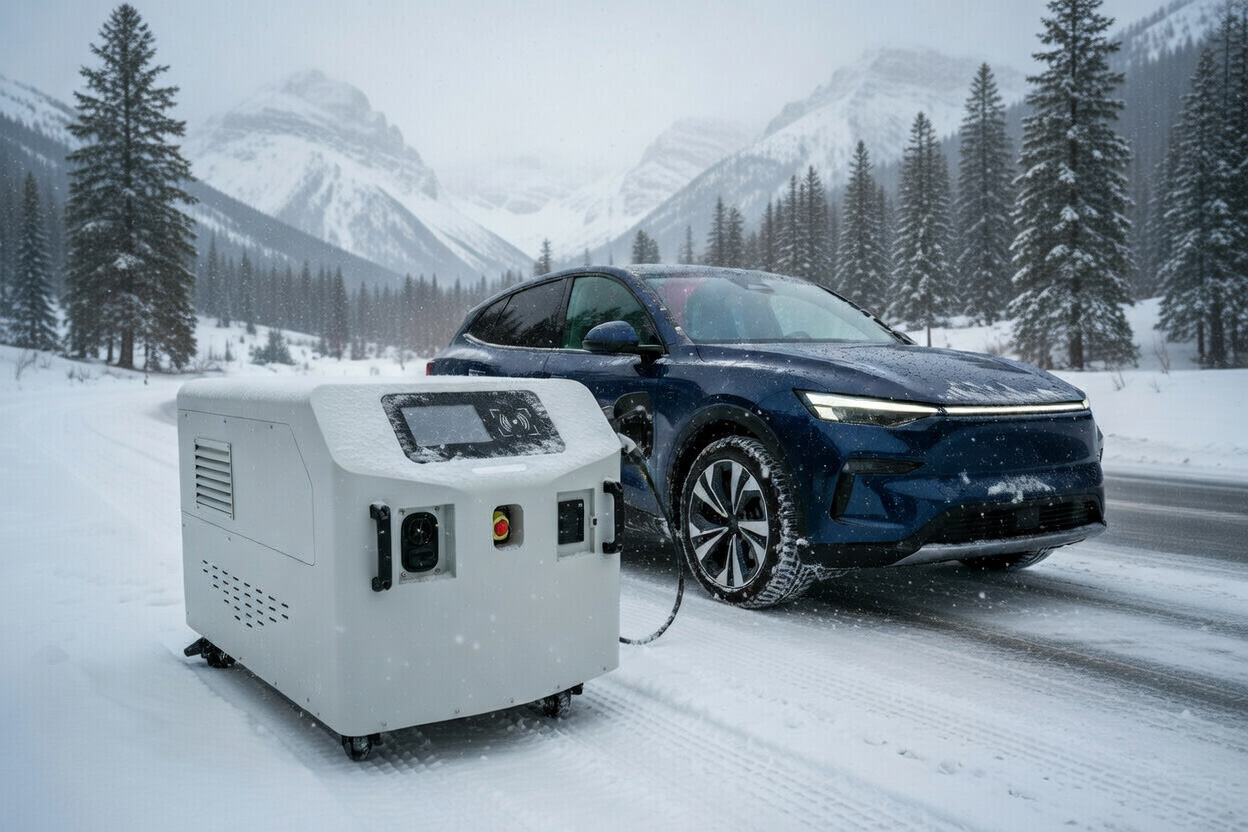
Off-Grid Mobile EV Charging System
—
The Industry Is Quietly Moving Toward Energy Platforms
One interesting shift happening right now is that charging companies are slowly turning into energy management companies.
The charger itself is becoming only one component inside a much larger infrastructure system.
Power routing, storage balancing, renewable integration, load forecasting, and distributed energy management are starting to matter just as much as charging speed.
That is why future charging infrastructure will likely be designed less like standalone charging stations and more like localized energy platforms.
—
Final Thoughts
For years, the EV charging industry focused heavily on increasing charger output power.
But the next stage of infrastructure development is increasingly about managing energy intelligently rather than simply delivering higher charging speeds.
Microgrid architectures, battery storage integration, and DC-based energy systems are becoming central to solving the real infrastructure limitations behind large-scale EV charging deployment.
