

Blog
Why Weak Grid Areas Are Becoming One of the Biggest Challenges for EV Charging Expansion

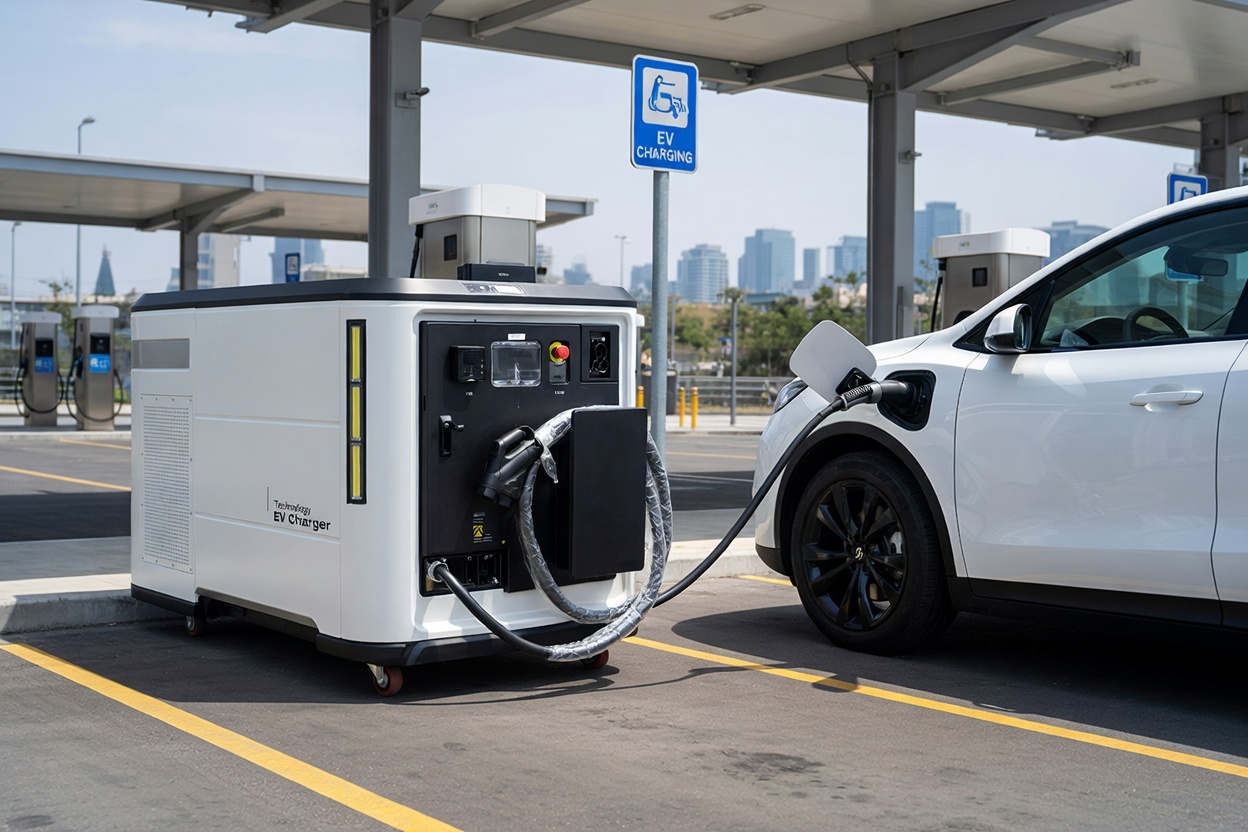
Why Weak Grid Areas Are Becoming One of the Biggest Challenges for EV Charging Expansion
A lot of EV charging discussions still assume one thing:
stable and unlimited grid power is available everywhere.
In reality, that is often not true.
Especially once fast charging infrastructure starts moving outside major urban centers.
Many regions already struggle to support large industrial loads, and high-power EV charging adds a completely new type of demand onto electrical infrastructure that was never originally designed for it.
This is becoming one of the biggest hidden bottlenecks behind EV charging expansion globally.
—
What “Weak Grid” Actually Means
The term “weak grid” does not necessarily mean the grid is unstable all the time.
In many cases, it simply means:
- limited available capacity
- voltage fluctuation under heavy load
- insufficient transformer sizing
- long-distance power distribution
- poor infrastructure scalability
A location may technically have electricity available, but not enough spare capacity for multiple high-power EV chargers.
This becomes especially obvious once charging power starts reaching:
- 120kW
- 180kW
- 250kW+
At those levels, the charging site starts behaving more like a small industrial facility than a traditional commercial building.
—
Why EV Charging Creates Difficult Load Patterns
One of the reasons EV charging stresses electrical infrastructure so heavily is that charging demand can change extremely quickly.
Traditional buildings usually have relatively predictable load behavior.
EV charging does not.
A charging station may operate at low power for hours.
Then suddenly several vehicles arrive and site demand jumps by hundreds of kilowatts almost instantly.
That kind of rapid load increase is difficult for weaker grid infrastructure to handle efficiently.
Especially in:
- rural areas
- industrial parks
- temporary projects
- older urban infrastructure
- developing regions
—
Grid Upgrades Are Often Slower Than Charger Deployment
One interesting problem in the charging industry right now is that charger technology is advancing much faster than utility infrastructure.
Installing a charger may take weeks.
Upgrading grid infrastructure may take:
- months
- years
- large utility coordination processes
In some regions, operators are discovering that obtaining enough utility capacity becomes the main project delay.
Not the charger hardware itself.
—
The Infrastructure Cost Can Become Surprisingly High
Many people underestimate how expensive electrical infrastructure upgrades can become for fast charging sites.
Once charging power increases significantly, projects may require:
- larger transformers
- medium-voltage connections
- switchgear upgrades
- substation expansion
- utility construction work
In some commercial projects, utility-side infrastructure costs exceed the charging equipment budget.
This is one reason why operators increasingly look for alternative system architectures.
—
Battery Storage Starts Solving Several Problems at Once
Battery-integrated charging systems are becoming more attractive because they reduce dependence on instantaneous grid power availability.
Instead of forcing the grid to directly support every charging peak, the battery system helps buffer demand fluctuations.
That changes the infrastructure requirements considerably.
The charging station can:
- charge storage batteries gradually
- discharge at higher power when vehicles arrive
- reduce sudden grid demand spikes
- operate under limited grid capacity
This architecture is becoming increasingly important in weak-grid environments.
Related system:
Battery Buffered EV Charging System
—
Why DC-Coupled Architectures Are Getting More Attention
Another shift happening quietly across the industry is increased interest in DC-based infrastructure design.
A lot of energy systems connected to EV charging are already naturally DC:
- solar panels
- battery storage
- EV batteries
Traditional AC-coupled systems require multiple conversion stages before energy finally reaches the vehicle battery.
In larger charging deployments, those conversion losses and system complexity become more noticeable.
DC-coupled architectures simplify the energy path:
solar → DC bus → battery storage → EV charging
This becomes particularly useful when grid capacity is constrained.
Related architecture:
Solar DC EV Charging System
—
Off-Grid Charging Is Becoming More Practical Than Before
A few years ago, fully off-grid EV charging sounded unrealistic for most applications.
That perception is changing gradually.
Improved battery technology and falling solar costs are making localized charging infrastructure more feasible in certain scenarios.
Especially where extending utility infrastructure is difficult or expensive.
Examples include:
- mining sites
- construction projects
- temporary charging deployments
- remote logistics operations
- mobile emergency charging
These are no longer purely experimental use cases.
Related solution:
Off-Grid Mobile EV Charging System
—
The Industry Is Gradually Shifting Toward Energy Management
One thing becoming increasingly clear is that future charging infrastructure is not only about installing more chargers.
It is about managing energy more intelligently under real infrastructure limitations.
The industry is slowly shifting from:
“charger deployment”
toward:
“distributed energy infrastructure management”
That shift is driving growing interest in:
- microgrids
- battery buffering
- DC architectures
- renewable integration
- localized energy systems
—
Final Thoughts
Weak-grid environments are becoming one of the biggest practical challenges for large-scale EV charging deployment.
As charging power continues increasing, many existing electrical networks struggle to support the required infrastructure economically.
This is why battery-integrated charging systems, DC-based architectures, and localized energy management solutions are becoming increasingly important in modern EV infrastructure projects.
