

Blog
Off-Grid Solar EV Charging Solutions: System Design, Applications and Real-World Use Cases

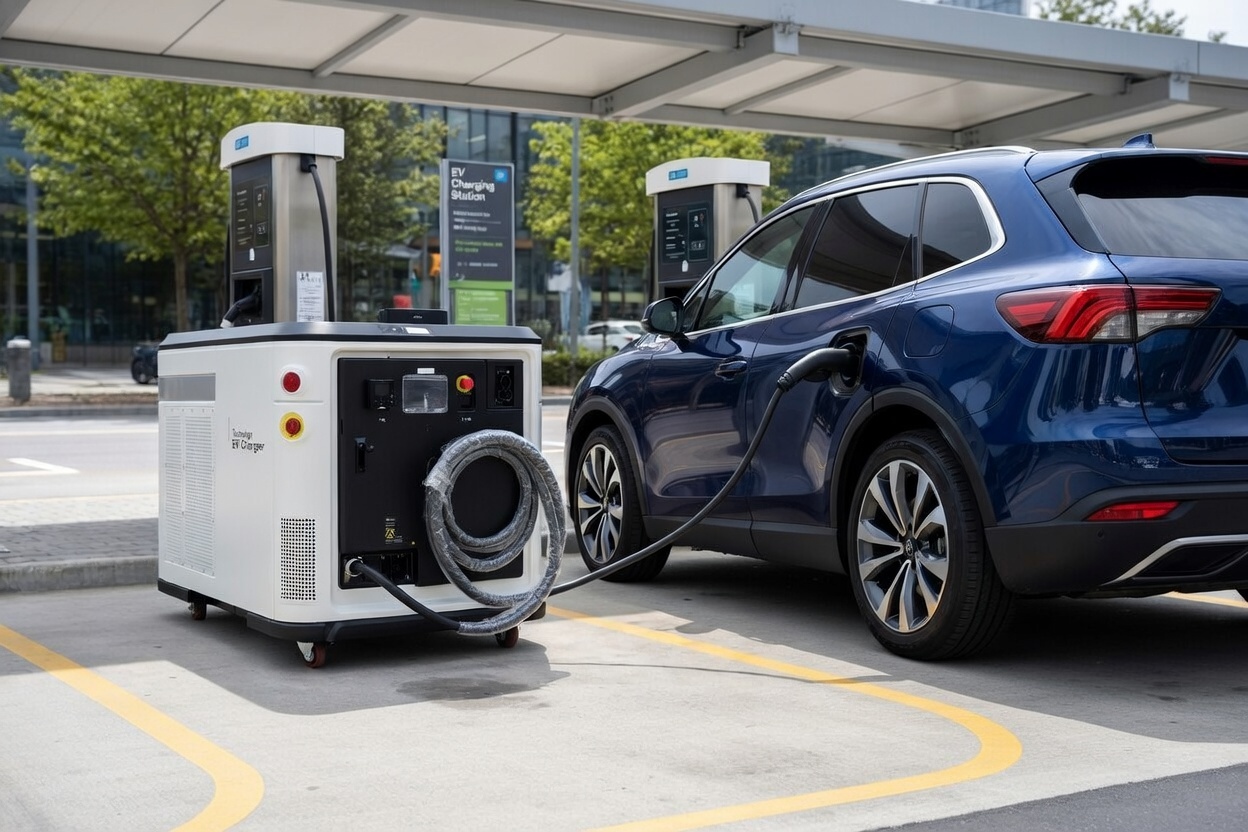
Off-Grid Solar EV Charging Solutions: System Design, Applications and Real-World Use Cases
As electric vehicles expand into commercial fleets, remote areas, and decentralized energy systems, traditional grid-dependent charging infrastructure is no longer sufficient in many applications.
Off-grid solar EV charging solutions are emerging as a practical alternative for locations where grid access is limited, expensive, or unstable. These systems combine photovoltaic generation, power electronics, and energy storage to enable independent EV charging without relying on the utility grid.
—
1. What Is Off-Grid EV Charging?
Off-grid EV charging refers to electric vehicle charging systems that operate independently from the electrical grid.
Instead of relying on grid electricity, these systems use locally generated renewable energy—primarily solar power—often combined with battery energy storage systems.
This allows EV charging infrastructure to be deployed in remote or infrastructure-limited environments.
—
2. How Off-Grid Solar EV Charging Systems Work
A typical off-grid solar EV charging system integrates three core components:
- Solar photovoltaic generation system
- Energy storage system (battery)
- EV charging power electronics system
Energy flow concept:
Solar PV → Power management system → Battery storage → EV charging output
In more advanced designs, DC-coupled architecture is used to reduce conversion losses and improve overall system efficiency.
—
3. Why Off-Grid EV Charging Is Becoming Important
The growth of EV adoption is no longer limited to urban areas. Many emerging applications require charging infrastructure in locations where grid expansion is not economically feasible.
Key drivers include:
- Expansion of EV fleets into rural and industrial regions
- Increasing demand for sustainable infrastructure
- High cost of grid expansion in remote areas
- Need for energy independence in critical infrastructure
—
4. System Architecture of Off-Grid Solar EV Charging
Off-grid EV charging systems can be designed using different architectures depending on efficiency and application requirements.
AC-Based Off-Grid System
In AC-based systems, solar energy is converted into AC power before being used for EV charging, introducing multiple conversion stages.
DC-Based Off-Grid System
In DC-based architectures, solar energy and battery storage operate within a unified DC system, reducing conversion losses and improving efficiency.
Simplified DC flow:
PV DC → DC power management → Battery → EV charging
—
5. Role of Battery Storage in Off-Grid EV Charging
Battery energy storage is a critical component in off-grid systems because solar energy is intermittent.
Storage systems help:
- Stabilize charging output
- Enable nighttime EV charging
- Balance solar energy fluctuations
- Improve system reliability
In many modern designs, battery buffering significantly improves system usability and reduces dependence on real-time solar generation.
👉 Related system:
Battery Buffered EV Charging System
—
6. Key Applications of Off-Grid EV Charging
Remote Infrastructure
Used in rural highways, remote villages, and isolated infrastructure where grid expansion is not available.
Industrial Sites
Mining operations, construction sites, and temporary industrial projects often require independent EV charging systems.
Tourism and Hospitality
Eco-resorts, islands, and remote tourism destinations use off-grid EV charging to support sustainable transportation.
Emergency and Mobile Charging
Mobile EV charging systems can be deployed for temporary or emergency energy supply.
👉 Example solution:
Mobile Off-Grid EV Charging System
—
7. Advantages of Off-Grid Solar EV Charging
- Independence from grid infrastructure
- Reduced infrastructure expansion cost
- Flexible deployment in remote areas
- Integration with renewable energy sources
- Scalable system design
These advantages make off-grid EV charging a key enabler for decentralized energy systems.
—
8. Challenges in Off-Grid EV Charging Systems
Despite its advantages, off-grid EV charging also presents engineering challenges:
- Energy storage sizing and management
- Solar variability and weather dependency
- System cost optimization
- Power electronics complexity
Proper system design is required to ensure stable and efficient operation under different environmental conditions.
—
9. Future of Off-Grid EV Charging Infrastructure
As renewable energy penetration increases and EV adoption expands globally, off-grid charging systems will play an increasingly important role in distributed energy infrastructure.
The integration of solar generation, battery storage, and DC power systems is expected to become a standard architecture for remote and commercial EV charging applications.
—
Final Perspective
Off-grid solar EV charging is not just an alternative to grid-based charging—it represents a shift toward decentralized and renewable-powered transportation infrastructure.
By combining solar energy, energy storage, and efficient power conversion systems, off-grid EV charging enables electric mobility in locations where traditional infrastructure is not feasible.
As system architectures continue to evolve, DC-coupled designs and integrated energy systems will play a central role in improving efficiency and scalability.
